
How agencies make account and project management work together
Over the past couple of years, a lot of my work with agencies has come back to one question: How can we use the natural tension between account management and project management to make the work better? Hearing how people are working through that tension at their own agencies gave me a few new ways to think about it.
AM:PM 2026 recap
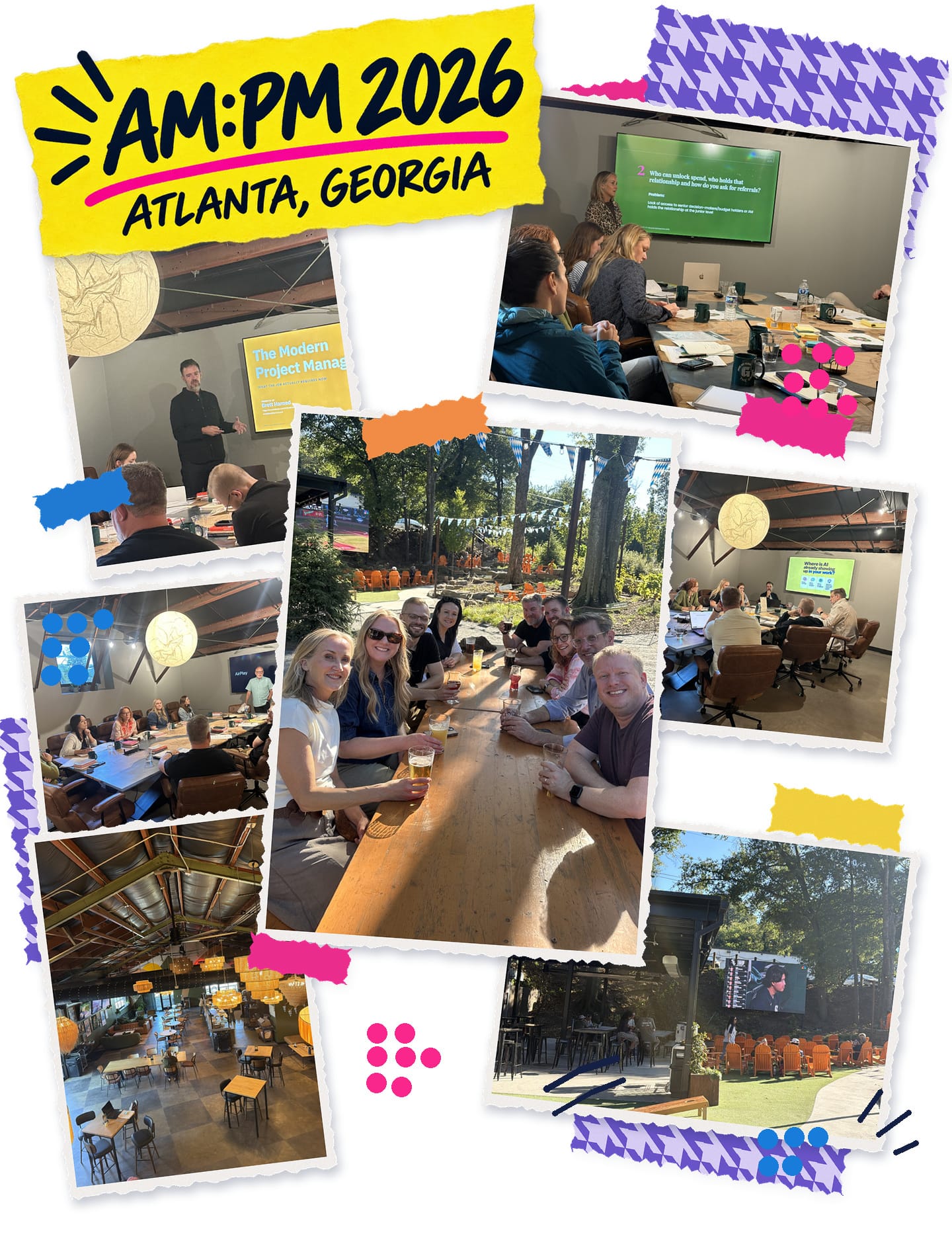
How do you take care of your team, do good work for your clients, adopt AI, and grow the agency at the same time? That’s what Jenny Plant and I wanted to talk about at our AM:PM Event in Atlanta.
Currently, I’m working with more agencies that are separating account management and project management, and a new org chart only gets you so far. You still have to figure out what each role needs from the other, what decisions people can make on their own, and how anyone is supposed to find time to grow an account when they’re already busy delivering the work.
David C. Baker started this seminar, and he and Jonathan built it over several years at Punctuation. As David’s work shifted toward mergers and acquisitions, he handed the event over to Jenny and me. I was glad he came to Atlanta to open it. He talked about patterns and cycles in the agency business and why this moment might feel more unprecedented than it really is. People kept coming back to his talk over both days, which is always a good sign that someone gave the room something worth chewing on.
What are we asking our AMs and PMs to do?
Jenny came over from England, where she’s spent years training agency account managers, and brought a framework I’ve been thinking about ever since. She walked us through four levels of client value, from reliably delivering what you promised to helping clients figure out what they should do next. There’s a real difference between sending a report and being able to say, “Here’s what I think matters in this report, and here’s what I’d do about it.” That’s the kind of conversation that can lead to more work because it gives the client a good reason to do it. Jenny also made the point that agency leaders have to create the conditions for those conversations. If you want AMs to grow accounts, give them time to understand the client’s business and tell them which accounts are worth investing in.
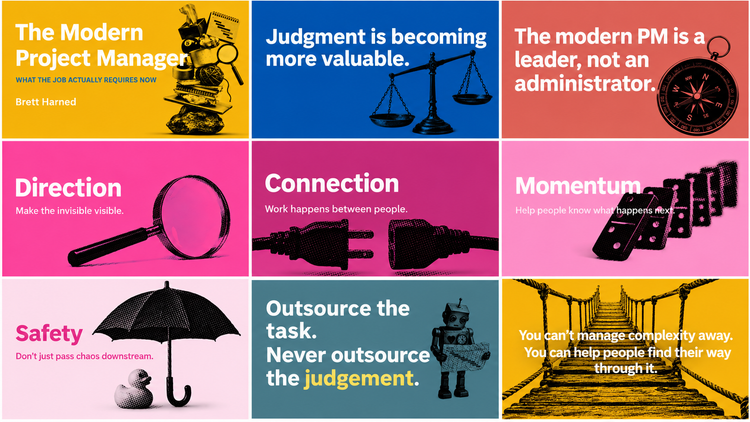
In my session on the modern PM, I asked people to score how well project management creates direction, connection, momentum, and safety in their agency. Then I asked them to pick the lowest score and think about what would move it up by one point. That’s where it gets interesting. A PM might need practice leading a difficult conversation. They might also be doing everything they can in a system that rewards saying yes, or they might have all the skill in the world and still need someone’s permission to push back on a deadline. Those are three different problems. Please don’t send all three people to the same training.
When Jenny and I brought the roles together, we looked at how different agencies actually divide the work. One pairs AMs and PMs on retainers and often gives shorter projects to a PM alone. Another pairs them on every project. We also got into the small habits that make either setup work, like taking a few minutes before a client meeting to agree who’s covering what, then checking in afterward about what you heard and who’s following up. I like that one because you can try it this week without announcing a transformation initiative.
We made the workflow earn its AI
For the workshop on the second day, we got out the sticky notes and mapped how work actually happens. Where does it slow down? Where do people have to make a decision? Who owns the outcome? Once we’d made the workflow clearer, we asked what AI should do at each step. Could it do the task, assist someone, offer advice, or stay out of it entirely? That’s an approach I explore in Project Management for Humans, Second Edition. A tool can save you time drafting an internal kickoff agenda. Someone on the team still has to make sure it reflects what the client was promised and what the team can deliver.
I also got to sit back and learn for a bit when Ben Kalkman showed us the “AI brain” he’s been building. I appreciated getting to see the work itself and hear from someone who’s spent real time figuring out how to make it useful. Ben shares what he’s learning in his newsletter, too.
The small room was the good part
We had 10 people at The Garage at Monday Night Brewing. That was smaller than Jenny and I expected, and I’d happily do it that way again. We could follow a question long enough to hear how an owner, an ops lead, and a PM might each approach it. There was also time to keep talking over lunch or outside over a beer, which is often where someone tells you how they actually got a new practice to stick.
All of the attendees who responded to the post-event survey said the small group made the event significantly better. One wrote, “I loved hearing about the real world applications of AM from other attendees.” They also pointed out that some of those examples came up over breakfast or drinks and were hard to recall later. Fair. If we do this again, I’d love to capture a few of those ideas as we go so people have them when they’re back at work and trying to explain what they want to change.
We closed the event by asking everyone to pick one thing they were actually willing to do differently when they got home. I came home with one of my own. The next time I’m tempted to squeeze in another slide, I’m going to leave a little more room for someone to say, “Here’s what we tried.”
TL ; D R - Jenny Plant and I hosted the AM:PM Event in Atlanta to work through a question a lot of agencies are facing. How do you take care of your team, do good work for clients, adopt AI, and grow the business at the same time? We compared how agencies split account and project management, mapped where AI could help with real workflows, and had enough time to hear how people were making it all work back home. Turns out the small room was the best part.

Member discussion