
The project plan was never the job
Project management has changed a lot since I wrote the first edition of Project Management for Humans. Oddly enough, all that change has made me more convinced that the human parts of the job matter most.
Last week, Jenny Plant and I hosted the AM:PM Event in Atlanta, bringing together a small group of account managers, project managers, and agency owners for two days of talking about how agencies actually work.
I presented a session called “The Modern Project Manager,” which gave me an opportunity to share some of the ideas I’ve been thinking about while writing Project Management for Humans, Second Edition.
The first edition came out in 2017. When we decided to do a second edition, I figured I would update some examples, add some new material, clean up a few things that hadn’t aged particularly well, and move along.
That was adorable.
Once I started digging in, I realized how much had changed around project management. We work remotely. Teams are leaner. Communication is scattered across seventeen different places. Roles are blurrier. Clients expect more visibility and more speed. And now AI can do a meaningful amount of work that, until fairly recently, we would have called project management.
I also realized something I wasn’t necessarily expecting: the human parts I wrote about in the first edition matter even more now. If the first edition of Project Management for Humans was about making project management more human, the second is about why that matters even more now.
We were never hired to move rectangles around
We have a funny way of describing project management. Basically, it's: Plans. Timelines. Budgets. Meetings. Tasks. Status reports. Tools.
All of those things matter. They’re part of the job. But I think we’ve spent way too much time defining project management by the things we produce and maintain, rather than what we actually accomplish.
If you watched a PM work without hearing any of their conversations, you might reasonably conclude that our primary contribution to society is moving rectangles around a screen.
Move the task. Change the date. Assign the person. Update the timeline. Move another rectangle. Repeat until retirement or until someone announces that the company is migrating to an entirely different project management tool because this one is finally going to solve everything.
The rectangles aren't the work. Neither are the plans themselves. They represent work being done by people, and people have an annoying habit of making things unpredictable.
Clients change their minds. Someone gets sick. Priorities shift. A decision that was supposed to take two days takes two weeks. Someone says yes when they clearly mean no. The thing everyone agreed would be easy turns out to be incredibly difficult.
The project plan is our best current guess about how the work will happen. Then reality shows up. I think that's where project management gets interesting.
The job underneath the job
When I think about what made me a good PM, I don't think it had much to do with my talent for making project plans (though they were works of ART). I think it was because I was adaptable. I was good with people. I could usually read a room, figure out what a team needed from me, and adjust. And I wasn't afraid to call bullshit when I needed to.
In the first edition of Project Management for Humans, I wrote about being a “lovable hardass.” I still use that phrase all the time because it's basically how I've always operated. I want to be approachable. I want people to trust me and know that I'm on their side. But I'm also going to hold people accountable and say something when I think we're making a bad decision. I'm pretty sure I got that from my dad. He's King LH.
I think that's a huge part of being a good PM. You're constantly figuring people out. Who needs more context? Who needs you to back off? Who needs help? Who needs a push? Who said they understood the assignment but clearly didn't?
That's the stuff that's hard to put into a project plan or a job description, but it's a huge part of the job. We're trying to help a group of people do good work together, while dealing with all of the weird, messy human stuff that inevitably gets in the way.
Timelines and budgets and status reports help us do that, but they're not the reason we're there.
The modern PM needs room to lead
I've been talking about project managers as leaders for years, usually with the caveat that most of us are leading without any real authority over the people doing the work. But the longer I've done this, the more I think we need to be careful about what we mean by that. PMs might not need traditional authority, but they absolutely need the trust and support to make decisions and actually lead.
I've worked in an organization where PMs had almost none of that. We weren't included in important client conversations, we didn't always have the information we needed, and we weren't treated like we had much of a voice in the work. Yet somehow we were still expected to control everything and answer for it when something went wrong. I fought against that pretty hard because you can't hold someone responsible for a project while cutting them out of the conversations that shape it. That sets them up to fail.
I've also had the exact opposite experience. Years ago, a challenging client escalated an issue to my CEO. He could have handled it in plenty of ways, including stepping in and taking over. Instead, he backed me up. He knew my track record, trusted how I was handling the situation, and made it clear to the client that he supported me.
I still remember that because it changed how I felt in the role. I knew I had some room to operate. I could make a tough call or have an uncomfortable conversation without wondering if someone was going to undermine me the minute the client complained.
That's the kind of authority I think PMs need. It isn't about being the boss or getting the final say on everything. It's knowing that the organization trusts you enough to do the job you're being asked to do.
Because we ask a lot of PMs: Take ownership, be proactive, challenge assumptions, protect the team, push back on scope, manage the client, and yes, lead. If that's what we expect from them, we have to give them enough room to actually do it.
So what does a modern PM actually create?
For my AM:PM session, I wanted to get people out of the weeds of project management for a minute. We can make endless lists of what PMs do: plans, status reports, meetings, budgets, timelines, tickets, documentation. But none of that really tells you whether project management is working well for your team.
So I asked a different question: When project management is working really well, what does it create?
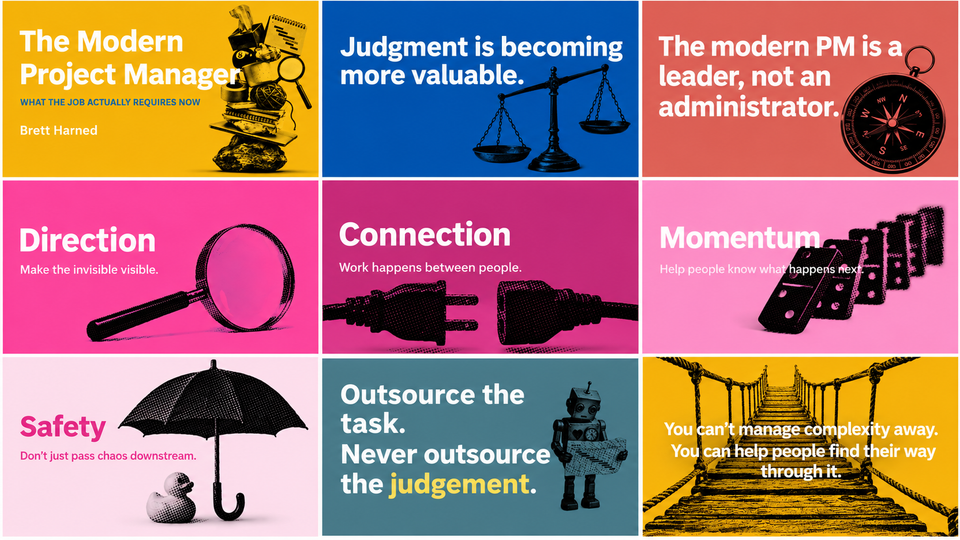
I landed on four things: direction, connection, momentum, and safety.
Direction means people understand where they're going, what matters, and what they're responsible for.
Connection means the right people are communicating, information is flowing, and the team is actually working together.
Momentum means the work keeps moving. Decisions get made, blockers get addressed, and people know what needs to happen next.
Safety means people can raise concerns, ask questions, disagree, and talk about what's not working without creating even more problems in the process.
I had everyone rate their project management function from one to five in each area. And that's where the exercise became useful. Instead of debating whether PMs should be doing more status reports or running meetings differently, they could look at the bigger picture. Maybe the team has plenty of direction but struggles with momentum. Maybe communication is great, but people don't feel comfortable raising problems. Maybe everything is a three.
It's a simple exercise, but I like it because it helps you evaluate project management based on what the function is actually creating for the organization, rather than how well everyone is keeping up with the task list.
The job is changing. Good.
One of the hardest parts of writing the second edition of Project Management for Humans has been figuring out how to talk about technology, particularly AI, in a book that I hope people will still find useful years from now. Things are changing so quickly that anything I write about a specific tool or capability could be outdated before the book lands on my own desk.
But the more I worked on the book, the less worried I became. Tools will change. Some of the tasks we've always associated with project management will get easier, faster, or disappear altogether. I'm fine with that. I don't think anyone got into this career because they dreamed of spending their days updating Jira tickets and writing status reports.
AI can draft the status report, summarize the meeting, identify a risk, or help build the plan. That is all obviously great, but someone still has to decide whether the plan makes sense, whether the risk actually matters, whether the team really agreed, and when it's time to pick up the phone and have a difficult conversation. That's judgment, and I think it's becoming more valuable, not less.
What I don't see disappearing is the need for someone who can make sense of a messy situation, bring people together, ask good questions, challenge a bad decision, help a team get unstuck, and figure out what to do when the plan inevitably stops matching reality. That's the part of project management I've always cared about anyway.
If the first edition of Project Management for Humans was about making project management more human, the second is about why that matters even more now. The job is changing, but I think we're finally getting a clearer picture of what the job was supposed to be all along.
Project Management for Humans, Second Edition will be published in January 2027. Preorders open soon.
TL;DR: Project management is changing fast, but the job was never just about plans, timelines, status reports, and keeping all the rectangles in the right place. Great project management creates direction, connection, momentum, and safety. It requires understanding people, exercising judgment, and helping teams navigate all the messy stuff that doesn't fit neatly into a project plan. As AI takes on more of the task-based work, I think those human skills become even more important.


Member discussion