
Digital PM Summit 2026 recap: The future of project management is still human
After three days in Asheville with the digital project management community, I'm more convinced than ever that the future of our profession depends on people, not just processes or technology. Here's what I took away from a conference full of thoughtful conversations, practical ideas, and a few good laughs.
I founded the Digital PM Summit in 2013, so you'd think I'd figured out how to get through one without feeling completely exhausted and emotional by the end. Apparently not.
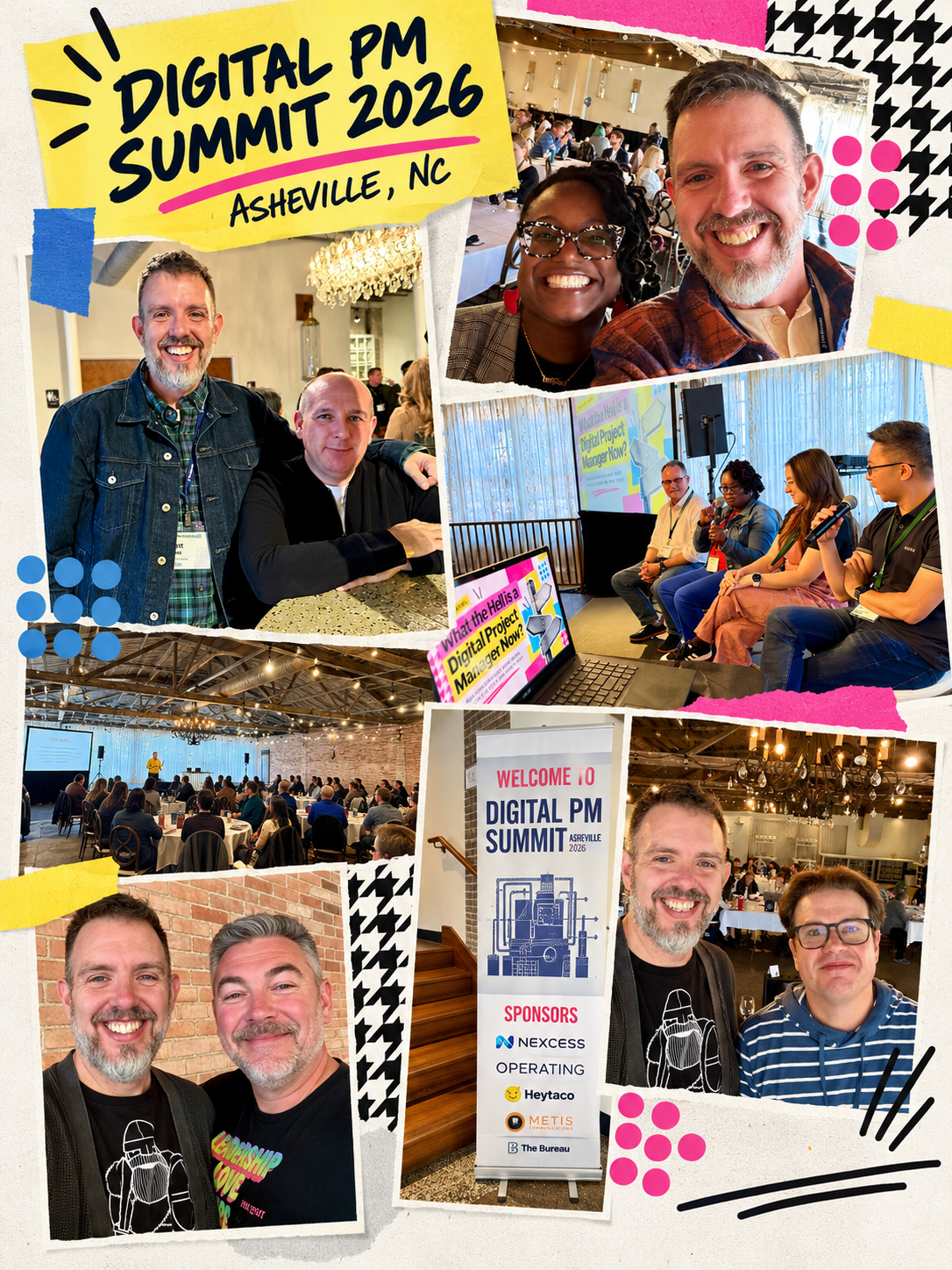
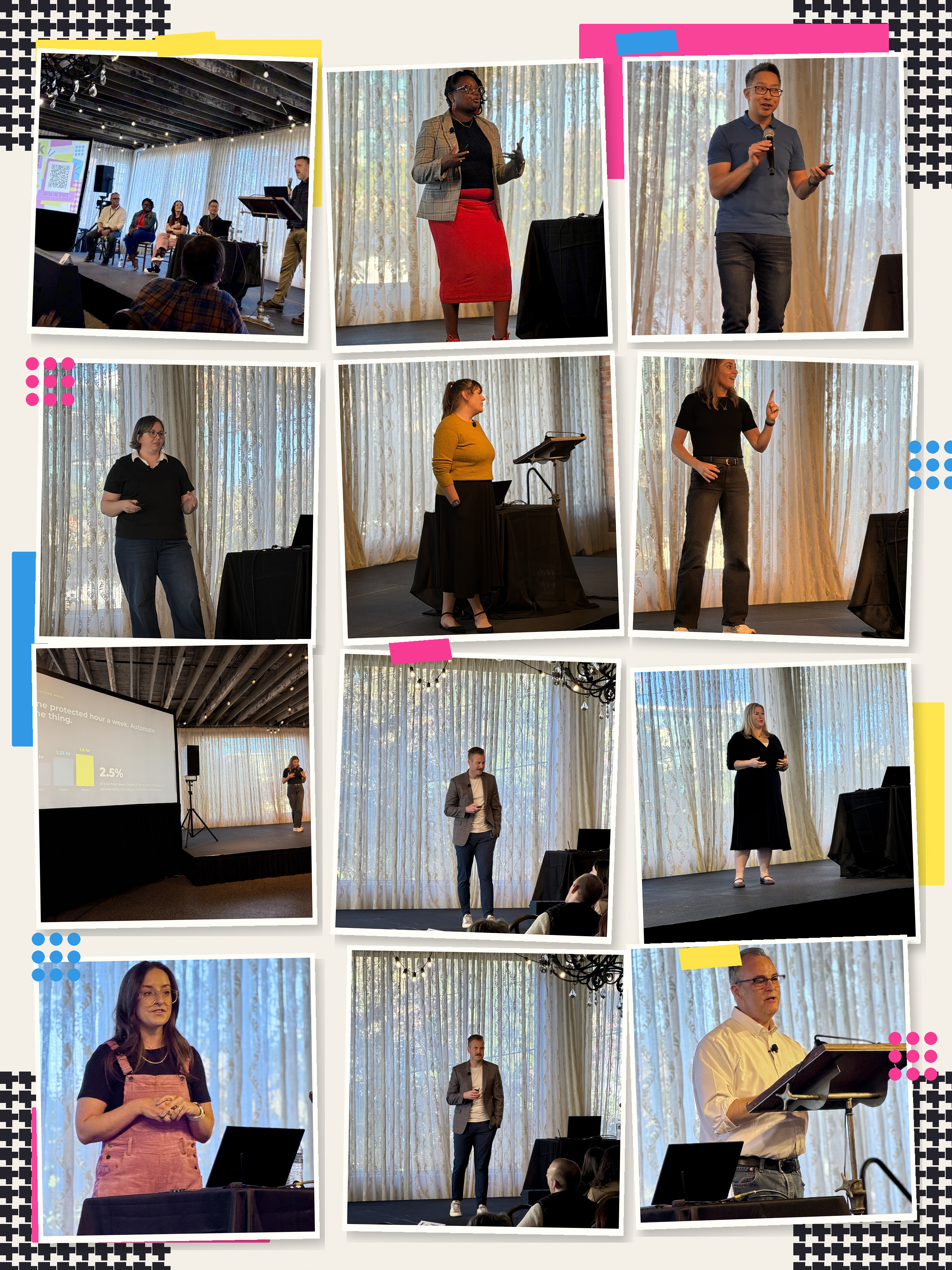
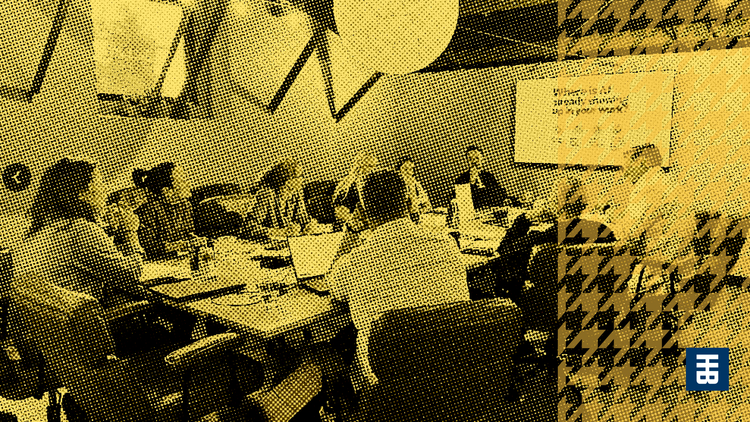
This year's Summit brought us to Asheville, North Carolina, where we spent October 19 and 20 talking about the changing role of project management, artificial intelligence, creativity, leadership, and the many challenges that come with getting groups of people to accomplish things together. I programmed the agenda, selected the speakers, hosted the two-day program, moderated conversations, and got to spend time with people I've known for years alongside others I was meeting for the first time.
I've always loved hosting this conference. There's something energizing about bringing a room full of project managers together, introducing people whose ideas I admire, and watching conversations develop between people who might never have met otherwise.
At one point, I led the room in reciting the Bureau oath together, and everyone joined in unison. When we finished, I felt like I was conducting a church service. Apparently, after all these years, I've become a preacher for the church of digital project management. At least this congregation understands the importance of a good agenda.
Jokes aside, that moment captured something I love about this community. We're a group of people who care deeply about a profession that is often misunderstood, occasionally underappreciated, and constantly changing. We show up because we want to do better work, but also because we want to feel connected to people who understand what that work actually involves.
And this year, I noticed a few themes running through nearly every conversation.
Project management has always been about people
One of the strongest themes of the conference was also one of the ideas that ios core to how I think about the profession: projects are fundamentally human endeavors. We can create all the plans, processes, and systems we want, but the work still depends on people understanding one another, making decisions, managing emotions, and building trust.
Kelly Vega explored this in her session on empathy for difficult clients and teammates. I particularly appreciated her reminder that most project problems are human problems that look operational. When someone seems difficult, there's usually more happening beneath the surface than the behavior we're reacting to. That doesn't mean we excuse poor behavior, but it does mean we should get curious before jumping to conclusions.
One idea I wrote down was to separate the person from the pattern. I love that distinction because it changes how we approach conflict. Instead of labeling someone as difficult, we can identify the specific behavior that's creating friction and address it directly. That's a much more productive conversation, and frankly, a more respectful one.
Jennifer Goebel approached the human side of project management from another angle, focusing on the everyday gestures that build trust within teams. Her message was a good reminder that strong relationships aren't necessarily built through elaborate team-building exercises or formal initiatives. They're built through small, consistent actions that demonstrate we see people, appreciate their contributions, and care about their experience.
Victoria Wheelehan brought that thinking into the world of digital transformation. Drawing on her experience in manufacturing and large-scale organizational change, she reminded us that the success of transformation is measured by people, not just technology. Implementing a new system is one thing. Helping people understand it, adopt it, and make it useful is something else entirely.
These sessions reinforced something I've been thinking about a lot while working on Project Management for Humans, Second Edition. Human-centered project management isn't about being nice or making everyone happy. It's about recognizing that human behavior, relationships, and emotions are central to how work gets done. Ignoring those things doesn't make us more efficient. It usually makes our jobs harder.
AI is changing the work, but it isn't replacing our judgment
Of course, we couldn't have a project management conference in 2026 without talking about AI. And we shouldn't. The technology is already changing how teams operate, what organizations expect from project managers, and how we spend our time.
I appreciated that this year's conversations moved beyond the usual demonstrations of prompts and productivity tricks. We talked about what happens to our roles when technology can handle more of the coordination and administrative work we've traditionally handled.
Kat Murphy challenged us to think about which skills we need to develop, which responsibilities we can delegate, and which parts of our jobs we might need to let go of entirely. I especially liked her emphasis on ownership. AI is something we need to understand, question, and actively shape within our organizations, rather than simply accepting whatever new tools or expectations get handed to us.
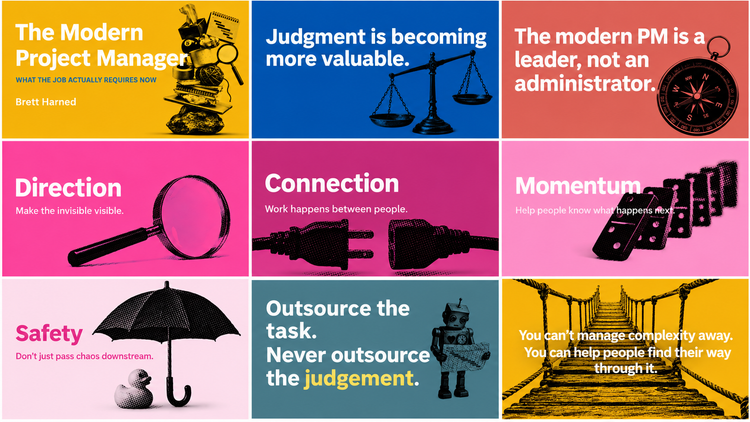
Chase Williams explored the idea of project managers becoming orchestrators of AI agents. It's an interesting shift in language because it suggests our value is moving further away from producing artifacts and toward directing work, exercising judgment, and making decisions. AI can help coordinate activities, but that doesn't mean it's managing the project in the fullest sense of the word.
And Dave Prior, who opened the conference with a keynote about finding the spark in our work, reminded us that the human side of project management is what we've always done. His talk wasn't about AI, but it offered an important counterpoint to the conversation. Project management is a creative profession, and our ability to improvise, connect ideas, support teams, and find joy in the work matters.
I left these sessions thinking that AI might finally force our profession to articulate its value more clearly. If the plans, schedules, summaries, and reports become easier to produce, we have to be able to explain what project managers contribute beyond those artifacts. I think that's a healthy challenge, even if it makes some of us uncomfortable.
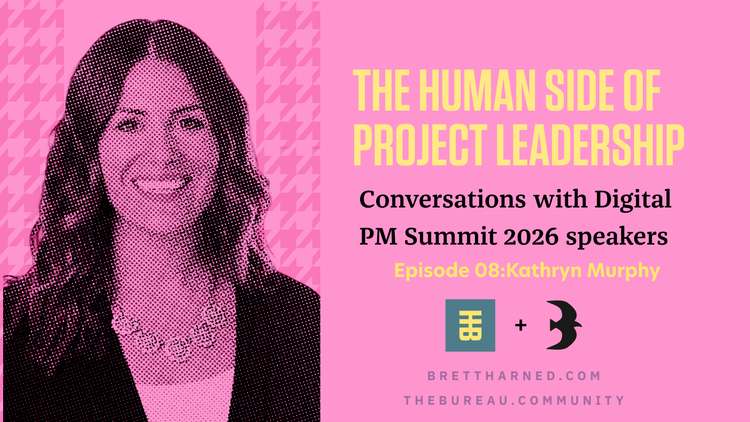
Don't forget to check out the conversations I had with our speakers leading up to the event, on the Human Side of Project Leadership Series on YouTube:


Good project management is an experience we create
Another theme that emerged was the idea that project management isn't simply something we do. It's something other people experience. The processes we establish, the relationships we build, and the way we respond when things go sideways all contribute to how people feel about working with us. And sometimes, the smallest decisions have the biggest impact.
Nick Cobb explored this in his talk about managing long-running enterprise web projects. Over time, project managers become more than delivery trackers. They become the keepers of context and often the primary relationship between the client and the team. Nick's reminder that problems get harder to fix when you let them drift resonated with me. The longer we wait to address a concern, the more complicated it becomes to resolve. And on a project that spans years, those small decisions and avoided conversations can really add up.
I was also so excited to introduce Blythe Meyers to the DPM stage. Blythe and I worked together at Happy Cog for about a year, hung out for a day in San Francisco, where she and her husband Kenny (and our friends) introduced me to cornbread pizza (core memory!), and we've stayed in touch ever since. But somehow, in all that time, I NEVER KNEW SHE DID IMPROV! Her session brought those two worlds together, exploring how active listening, adaptability, and the classic improv principle of "yes, and" can help project managers navigate uncertainty. I loved seeing her bring that energy and perspective to the stage, and it was a great reminder that sometimes the best thing we can do as leaders is stop trying to control every outcome and start responding to what's happening in front of us.
One person I was really disappointed not to see on stage was my friend Maggie Lynn, who unfortunately couldn't make it to Asheville. Maggie has some fascinating ideas about where project management and gaming intersect, and I was really looking forward to having her share them with the community. I had the pleasure of coaching Maggie last year, and our conversations were always thoughtful, creative, and genuinely fun. She's one of those people who makes you look at familiar problems from an entirely different angle. She's also started writing more about project management on her Substack, which is absolutely worth checking out. I'm hoping we can bring her to the Summit next year because I think this community would love what she has to say.
 Maggie Lynn, PMP®
What connects all of these perspectives is the idea that good project management requires both intention and flexibility. We need structure, but we also need the ability to respond to what's actually happening. We need plans, but we can't become so attached to them that we stop listening. And we need to remember that every meeting, email, decision, and interaction contributes to someone's experience of the project.
The best project managers don't just keep work moving. They create the conditions that help people do good work together.
Sustainable project management requires more than working harder
I was also glad to see conversations about sustainability and recovery woven into the program. Project managers are often rewarded for being available, responsive, and willing to absorb whatever chaos comes their way. That might make us look indispensable in the short term, but it's not a particularly healthy or effective way to build a career.
Crystal Richards closed the conference with a keynote about making time for recess. Yes, actual recess for adults. Her point was that recovery shouldn't be treated as something we earn after finishing all our work, because we all know how that story ends. There will always be another deadline, another problem, and another person who needs something.
Instead, recovery needs to be intentional. We should schedule time to step away, think, experiment, and recharge because those activities make us better at our jobs. (Side note: I'll be on a panel at Crystal's Indoor Recess Summit on November 6. Join us! And read Crystal's foreword to Project Management for Humans, Second Edition at the link below.)
 Brett Harned
Dave's keynote about creativity connected to this idea, too. When we reduce project management to a series of administrative obligations, we lose some of the curiosity and enjoyment that make the work rewarding in the first place.
I think our profession needs to spend more time talking about this. Not just burnout, but what a sustainable and fulfilling project management career actually looks like. How do we create space for creativity? How do we establish boundaries without feeling like we're letting people down? How do we lead teams without absorbing every problem as our own?
Those are leadership questions, and they deserve just as much attention as our methodologies and tools.
Community might be our most important professional resource
One of my favorite parts of the Summit was getting to sit down with Galen Low for a conversation about the past, present, and future of digital project management.
Galen and I have both spent years building communities around this profession, so it felt natural to talk about how the work has changed, what we've learned, and what still matters. We also discussed Project Management for Humans, Second Edition, and what it means to practice human-centered leadership in a world where technology is changing faster than most organizations can adapt. Plus, I got to announce that the book is on pre-sale, and I have 12 spots left for the PM for Humans, 2E Book Club!
 Brett Harned
Galen also delivered a lightning talk about community and career resilience. His message was especially relevant right now. When our roles are changing and the future feels uncertain, having a network of people who share ideas, challenge our assumptions, and support one another becomes incredibly valuable.
And I love that The Digital Project Manager is offering to help PMs set up meetups. It's about time we climb out of that post-Covid event slump and start seeing one another again. It's only been 6+ years.
I also moderated our panel, "What the Hell Is a Digital Project Manager Now?" It was a question worth asking because our profession has never been especially easy to define. We've always worked across disciplines, filled gaps, solved problems, and taken responsibility for things that don't fit neatly into a job description. AI is adding another layer of complexity, but the conversation reminded me that the adaptability of project managers has always been one of our greatest strengths.
And honestly, some of the most valuable conversations happened outside the formal sessions. They happened over coffee, at lunch, between presentations, and while catching up with people I hadn't seen in a year. One particularly meaningful reunion was with my friend Sam Barnes, whom I hadn't seen in person since before COVID. Sam came to Asheville simply to participate, catch up, and spend time with the community. It was wonderful having him there without either of us needing to worry about what he was presenting.
That's the part of the Summit that's difficult to explain to someone who hasn't attended. The content is important, but the connections are what keep many of us coming back.
Putting the ideas into practice with Rob Harr
One of the best parts of the event was following those conversations with a hands-on workshop alongside my friend and longtime collaborator, Rob Harr.
We wanted participants to leave with more than a collection of interesting ideas about AI and project management. Our goal was to help people think critically about how AI could fit into their actual work, what it might improve, and where human judgment and oversight still needed to play a central role.
Facilitating that kind of experience is one of my favorite things to do. I love seeing people work through an idea together, challenge assumptions, and gradually turn something abstract into something they can actually use. Rob brings a complementary perspective to those conversations, and it was a pleasure to collaborate with him again.
The workshop also reinforced one of my biggest takeaways from the Summit: the future of project management isn't about choosing between people and technology. It's about understanding how they work together, and being thoughtful about where each creates value.
A personal milestone for Project Management for Humans
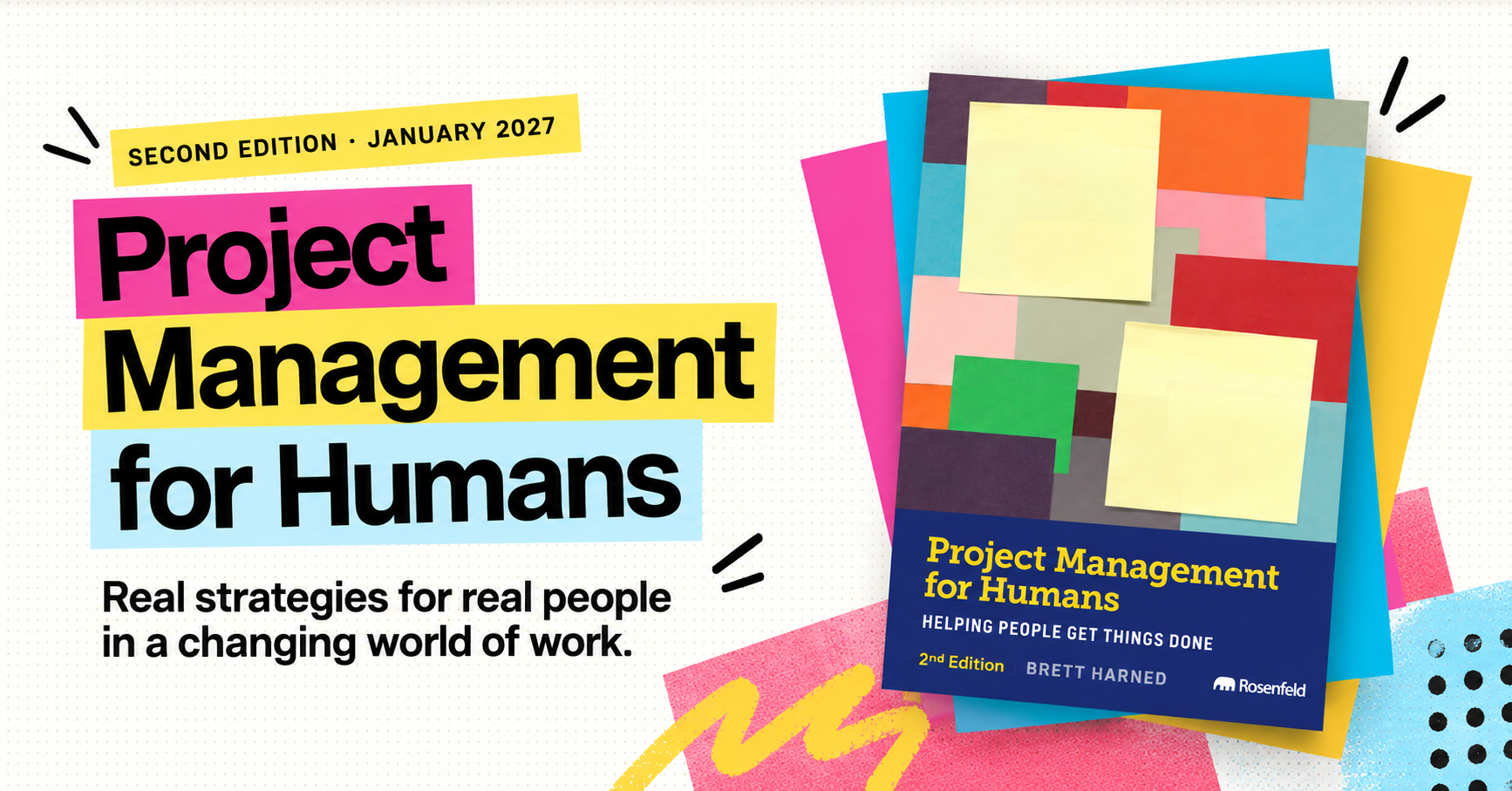
The Summit was also an opportunity to share something I've been working toward for a long time: Project Management for Humans, Second Edition is available for presale!
 Rosenfeld Media
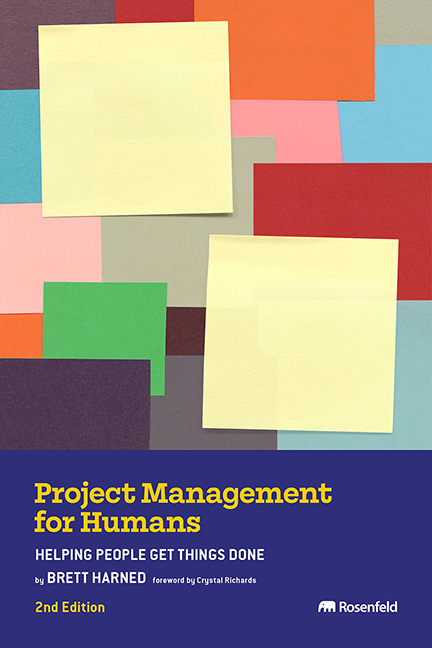
I announced the presale along with the Book Club during the conference, which felt particularly meaningful because this community has been part of the book's story from the beginning. The original edition grew out of years of conversations with digital project managers about the challenges they were facing and the skills they needed to succeed. Those conversations have continued to shape my thinking, and they've influenced the updates I've made for the second edition.
The profession has changed considerably since the first edition was published in 2017. AI is transforming our workflows, teams are navigating new expectations, and the responsibilities of project managers continue to expand. But the core message of the book remains the same: successful project management depends on understanding people, building relationships, communicating clearly, and leading with empathy.
Being able to celebrate that next chapter with a room full of people who care about this profession was pretty special. I'm excited to get the book into readers' hands and continue the conversations it inspires.
What I'm taking away from Asheville
I've been thinking about what connects all these ideas, and I keep coming back to the same conclusion. Our profession is changing, but the fundamental needs of the people doing the work haven't changed nearly as much.
People still need clarity. They need trust, support, and the confidence to make decisions. They need leaders who listen, communicate honestly, and recognize when something isn't working. They need opportunities to learn and grow, and they need space to do meaningful work without sacrificing their well-being.
Technology can help us create those conditions, but it can't take responsibility for them. That's our job.
I also left Asheville feeling grateful. Grateful to every speaker who shared their experiences and challenged our thinking, to the attendees who showed up ready to participate, and to Carl Smith, Meredith Durham, Lori Rice at The Bureau for continuing to invest in a community that means so much to me.
I started Digital PM Summit because I believed project managers needed a place to learn from one another and feel like they belonged to something. Fourteen years later, that belief hasn't changed. If anything, the conversations we had this year made me more convinced that this kind of community is essential.
We're already thinking about what comes next for 2027, including the possibility of bringing the Summit back to a city we visited pre-Covid. I'm excited about where we might go, who we'll meet, and what we'll learn together. Stay tuned for updates!
T L ; D R - This one was a doozy, and it came a full week after the event, but...Digital PM Summit 2026 brought project leaders together in Asheville to explore AI, creativity, empathy, sustainable work, and the evolving role of the PM. Across the talks, conversations, and hands-on workshop with Rob Harr, one idea kept resurfacing: the real value of project management lives in how we lead, support, and connect people. I also got to announce presales for Project Management for Humans, Second Edition, reconnect with old friends, and celebrate a community that's been an important part of my life for more than a decade. The tools will keep changing. The human work isn't going anywhere.

Member discussion