
Human-centered project management: A practical guide

This practical guide to human-centered project management draws on my work leading projects, coaching PMs, and helping teams work together. I’ll keep adding examples, questions, and resources over time, so you can return to it when a project needs a little attention.
You know that meeting where everyone agrees to the plan? There’s good conversation, a few thoughtful questions, and some nodding. You leave feeling like the project is finally moving. Then someone messages you: “There’s no way we can hit that date.”
Another person thought the deadline was flexible. The client thinks they’re reviewing a finished product next week. Your creative director has concerns they apparently decided to save for the director’s cut. You were all in the same meeting, but somehow you attended four different meetings.
This is where a lot of project management happens: in the space between what people say, what they understand, what they need, and what they actually do. A plan gives us something to work toward, but helping people understand and commit to it takes conversation, curiosity, and judgment. It takes someone willing to ask the question that makes the meeting run five minutes longer but saves three weeks of confusion.
That’s the work I mean when I talk about human-centered project management.
What is human-centered project management?
Human-centered project management is the practice of helping people work together effectively so they can make decisions, navigate uncertainty, and deliver meaningful outcomes.
It means paying attention to the people doing the work and the conditions they need to do it well, including their capacity, their understanding of the goal, and their relationships. It also means considering whether they can raise a concern without feeling like they’ve just volunteered to be the problem.
Those things affect delivery every day. A stakeholder who doesn’t understand a decision will revisit it. A team member who feels unsafe admitting they’re behind may stay quiet until the deadline arrives. A client who doesn’t know what feedback you need may send you a document containing the phrase “make it pop” eleven times. Each situation affects scope, time, money, and quality, and each requires a human conversation.
In my work as a PM, consultant, and coach, I keep coming back to how much depends on the way we handle those conversations. We need structure, and we need the judgment to make that structure useful to the people working within it. I explore this approach further in Project Management for Humans, Second Edition, coming in January 2027.
Here are a few ways to put that into practice.
1. Find out what people think they agreed to
We use words like aligned, approved, and ready with remarkable confidence. Then we discover that “approved” meant “I like the general direction, but my boss hasn’t seen it.” Shared language can hide very different expectations, so a human-centered PM gets specific enough to uncover those differences while there’s still time to address them.
Earlier in my career, I sometimes treated a quiet room as an aligned room. I was an inexperienced PM sitting with people who knew far more about their disciplines than I did, and I was nervous about whether they thought I belonged there. I’d put a lot of effort into preparing the plan because I wanted to show that I could do the job. When I asked whether anyone had questions and nobody did, I felt relieved. I’d made it through the meeting without being exposed as someone who was still figuring this out.
Looking back, I can see how much attention I was giving to my own performance. I was worried about looking prepared, keeping the meeting on track, and answering questions correctly. I wasn’t always leaving enough room to find out what people actually thought. A concern could feel like a judgment of my ability, even when someone was simply trying to help us make a better plan. That is a lot of emotional baggage to bring to a scheduling conversation, but there it was, sitting right next to my very organized agenda.
What helped was becoming more comfortable treating the plan as something we needed to work through together. I didn’t have to arrive with every answer. I did need to help us ask the questions that would make the plan workable.
Imagine a client asks your team to move a launch forward by two weeks. There’s an important event coming up, and they want the new website live beforehand. In the meeting, everyone agrees to explore it. By the next morning, the client is telling colleagues the launch date has changed.
You need to establish what was actually decided and understand what the event requires. Does the entire website need to launch? Would a smaller set of pages serve the immediate need? Who can make that call?
Useful questions include:
- What needs to be true for this date to work?
- What are we committing to today?
- Who else needs to weigh in before we confirm?
- What will we do if the content or approvals arrive late?
These questions turn enthusiasm into a conversation about commitments. Before you close a meeting, state the decision, the owner, and the next step, and give people a chance to correct your understanding. A brief recap can reveal a surprising amount of disagreement hiding beneath a very pleasant conversation.
2. Pay attention to how you receive bad news
Most PMs want people to flag problems early. Whether people actually do depends partly on what happens when they try.
People have told me that they can watch my face to know how I’m feeling. My resting pitch face is real, and apparently it does not require an invitation to participate in a meeting. When someone brings me a problem, I may already be calculating the impact, thinking about the client conversation, and wondering what we can do. Meanwhile, the person who brought me the information is watching my face do an entire presentation.
I’ve had to be conscious of that because the reaction I’m having internally can communicate something I don’t intend. I might be worried about how to help, while the person across from me thinks I’m frustrated with them. If they’ve taken a risk by admitting something is wrong, that distinction matters.
Think about the last time someone told you they were behind. Did you ask what had changed? Immediately remind them of the deadline? Start typing with the intensity of a person launching a missile? If raising a concern reliably earns someone a lecture, public embarrassment, or a pile of additional reporting, they may wait until they have exhausted every possible workaround. By then, your options may be limited.
You can hold people accountable and make it easier to tell you the truth. In our earlier-launch example, suppose a developer messages you after the meeting: “I don’t think we can do this.” Start by thanking them for raising it and asking them to walk you through the concern. Which work is affected? What assumptions are in the estimate? Are there dependencies other people haven’t considered? What could make the date achievable?
Once you understand the issue, you can explore why it surfaced privately. You might ask, “Was there something about that conversation that made it difficult to bring this up?” They may have needed time to think, or you may have moved the discussion toward agreement before they had a chance to assess the request.
The answer might tell you something useful about the meeting, the team dynamic, or your own facilitation. You still need a delivery decision, but you may also need to change how decisions get made.
3. Build plans that account for actual human beings
There’s a special kind of optimism involved in assigning someone forty hours of project work during a week containing twelve hours of meetings. Apparently, the work happens in a secret bonus week available only to whoever created the spreadsheet.
People need time to think, collaborate, review, revise, and recover from the other things competing for their attention. They also have commitments you may not see. A useful plan accounts for those realities.
Ask the people doing the work how they would approach it. Find out where they need input, where uncertainty is high, and what else is already on their plate. Include the time required for decisions and feedback, and make room for the parts of the work that involve figuring out what the work actually is.
For that accelerated website launch, moving the dates in your project tool takes about thirty seconds. Understanding whether the team can deliver takes longer. You might discover that design can move faster, but the client’s legal review still takes ten business days. Or that the developer with the relevant knowledge is committed to another launch. Or that nobody has taken ownership of the content.
Bring those constraints into the conversation so people can make choices with an understanding of the consequences. That might mean a smaller launch, additional support with a realistic onboarding period, or a later date. This is one of the most useful things a PM can do: help people make commitments they understand.
4. Have the conversation you keep postponing
You probably know which one: the stakeholder who keeps reopening decisions, the colleague who misses commitments and gets defensive when you ask about them, or the client whose “quick requests” have quietly become a second project.
It’s tempting to work around these situations. You send another reminder, absorb another task, or quietly rearrange the schedule, telling yourself you’re keeping things moving. Sometimes a workaround is necessary, but repeated workarounds can also conceal a problem until everyone considers it normal.
A human-centered approach means addressing the issue with enough clarity and curiosity to make progress. Suppose the client in our example has missed two content deadlines while continuing to push for the earlier launch. You could send another “just checking in” email, or you could make the impact explicit:
“We agreed to receive the content on Tuesday, and we’re still missing three sections. The team needs that material before we can build and review those pages. What’s getting in the way of finishing it?”
Listen to the answer. Maybe the writer is overloaded. Maybe the person responsible never agreed to the deadline. Maybe the content is waiting on an executive who has been mysteriously unavailable since the project began.
Once you understand the situation, work toward a clear agreement:
“We can explore launching the completed sections for the event and scheduling the remaining pages afterward. To assess that option, we need approval on the page list by tomorrow. Can you make that decision, or do we need someone else involved?”
You’ve explained the impact, investigated the obstacle, and offered a next step. The team still needs to confirm what is feasible, and the client may need to make a difficult choice. A useful conversation gives everyone better information to work with, even when the answer is disappointing.
More on difficult conversations: For a more personal perspective on navigating these situations, read DPM War Stories: The Difficult Conversation.
5. Make ownership visible, including your own limits
PMs are often good at noticing what needs to happen, and that ability can become a trap. You spot the missing task, so you pick it up. You see an unresolved decision, so you chase it. Someone needs to have an awkward conversation, and somehow your name appears on the calendar invitation. Eventually, you’re coordinating the project, filling three role gaps, and wondering why you can’t get to your actual work.
Helping a team includes making responsibilities clear. Who recommends an approach? Who decides? Who does the work? Who needs to be consulted? When something falls between roles, bring it into the open, explain what’s missing, and help establish an owner. If you temporarily take it on, make that arrangement explicit.
It also helps to recognize when a problem requires authority you don’t have. You can explain a capacity conflict, show its impact, and recommend a change, but leadership may need to decide which priority moves or whether to bring in support. Your willingness to help shouldn’t quietly become the organization’s staffing strategy.
Your own capacity belongs in this conversation, too. A project that depends on your constant availability has a problem worth addressing. The team needs a way to move work forward when you’re occupied, on vacation, or simply eating lunch like a person.
When everyone assumes someone else owns it: I once worked with a client who expected our team to coordinate their internal stakeholders, collect feedback, and chase approvals, even though we’d never agreed to that responsibility. In The most expensive phrase in agency delivery, I share what happened and why those assumptions need attention before the work begins.
Start with the project you’re already on
You don’t need to roll out a new framework to try this. Pick a current project and ask yourself:
- Where might people have different understandings of the goal or next milestone?
- What concern have I heard privately that needs a wider conversation?
- Whose capacity or input are we assuming will be available?
- What conversation am I postponing, and what is the delay costing us?
- What am I carrying that needs a clearer owner?
Choose one answer and act on it this week. You might clarify a decision, revisit a commitment, ask someone what’s making their work difficult, or bring an unspoken concern into the next meeting. Keep the action specific enough that you can tell whether it helped.
That’s how this approach becomes part of your practice: through the questions you ask, the commitments you help people make, and the way you respond when the work gets complicated. You’ll sometimes realize that you contributed to the confusion or that your first understanding of a problem was incomplete. Being willing to revisit those moments is part of the work, too.
The tools and plans matter. People have to use them together, under pressure, with competing needs and incomplete information. Helping them do that is a substantial part of the job. And the next time everyone nods in a meeting, you’ll know to ask one more question.
Give your project a human-centered check-in
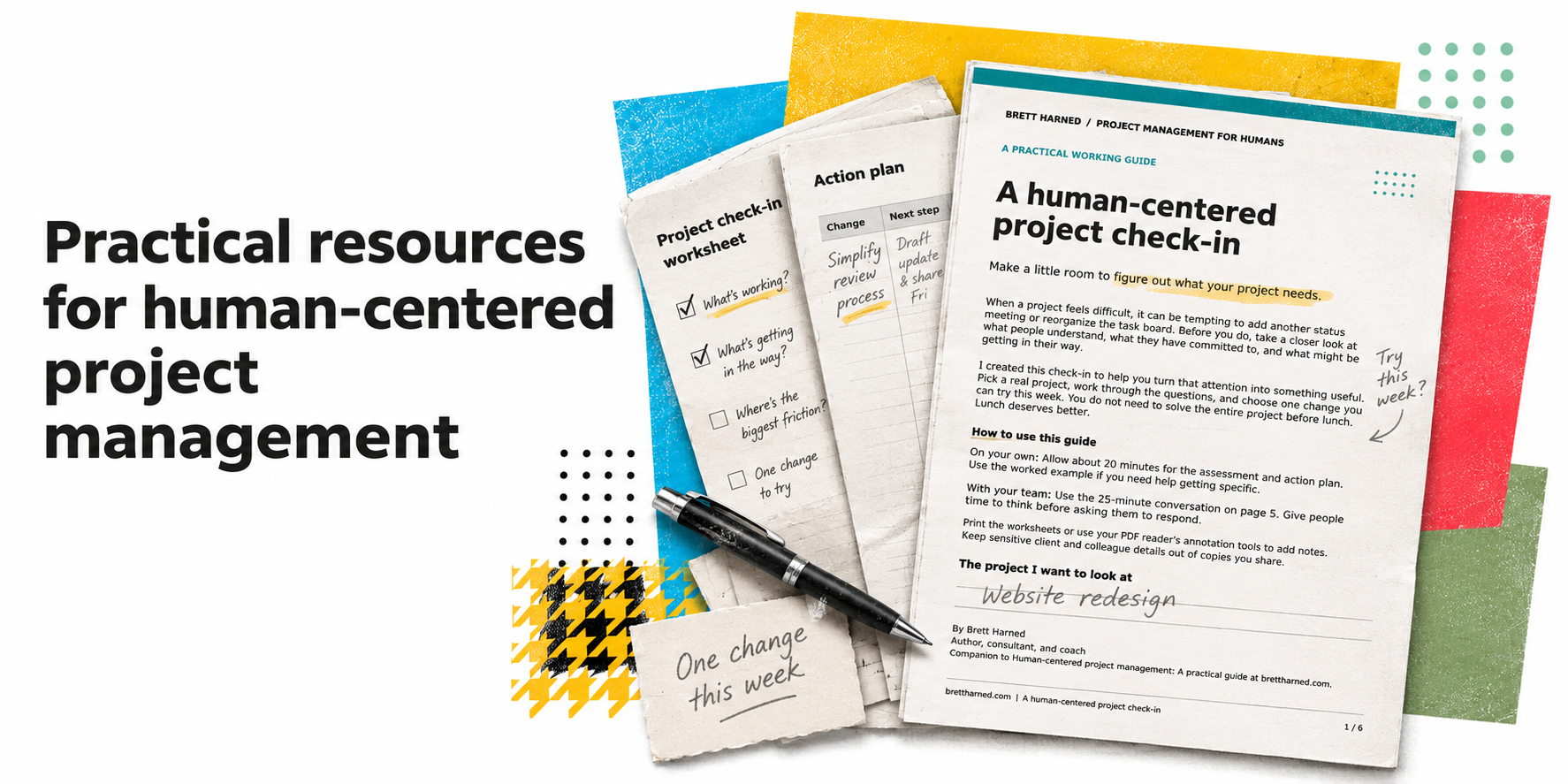
With Project Management for Humans, second edition now in the publisher’s hands, I’m starting to turn more of these ideas into practical resources you can use in your own work. I’ll be creating free downloads for newsletter subscribers, and this is the first.
A human-centered project check-in is a six-page working guide to help you take a closer look at a project you’re managing. It includes a project assessment, a worked example, a team conversation exercise, and space to decide what you’ll try this week.
Subscribe or sign in to grab your copy, and let me know how it goes. I’d love to hear what helped, what could be clearer, and what you’d like help with next. Your feedback will help me make these resources more useful.
T L ; D R - Human-centered project management means paying attention to what people need to understand, decide, and do their work well. In practice, that includes checking what people actually agreed to, making concerns easier to raise, planning around real capacity, addressing difficult conversations, and clarifying ownership. That includes noticing how your own assumptions and reactions affect the team. Start with a current project, choose one place where people are struggling, and take a specific action this week. Plus: a new, free resource!


Member discussion