
The Human Side of Project Leadership #002
What Happens When AI Does the PM Busywork?
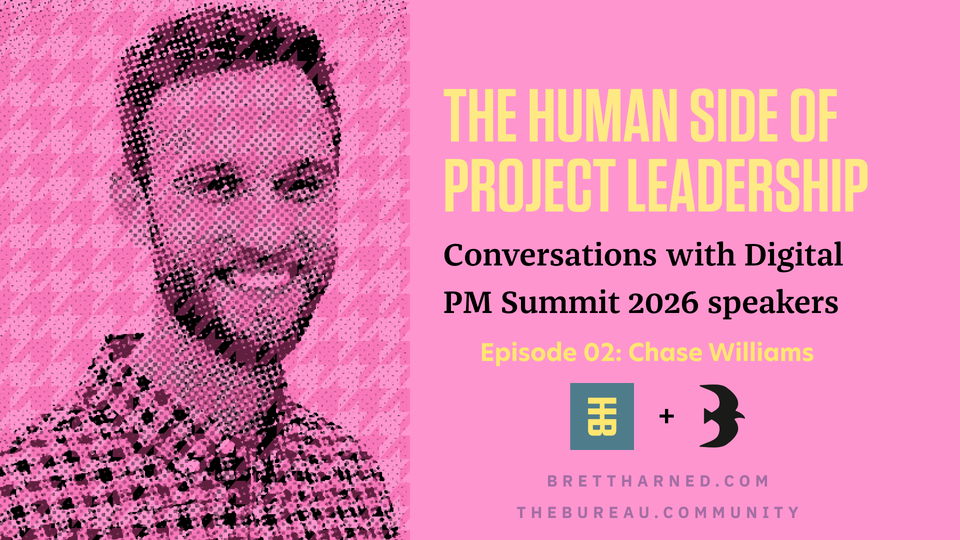
Featuring Chase Williams, Digital PM Summit 2026 Speaker
In my first conversation for The Human Side of Project Leadership, Blythe Meyers and I ended up talking about AI even though her session is about improv. That probably tells you something about where project management is right now.
AI kept showing up as I reviewed proposals and put together the program for this year's Digital PM Summit. But what interested me most wasn't necessarily the technology, the tools, or the latest ways to automate our work. It was what AI might mean for us.
Chase Williams, Senior AI Project Manager at KUNGFU.AI, is set to deliver a lightning talk titled "Managing Projects, Orchestrating Teams: The PM's Shift in the Age of AI" at the Summit, so I knew we'd uncover a lot in this conversation.
Chase's talk asks a question I think every PM should be considering: If AI can take on more of the administrative work we've traditionally done, what does that leave us to do?
As it turns out, maybe the most important parts of the job. Chase shared a story from earlier in his career when a VP pulled him aside after a meeting and asked him a pretty direct question: Why weren't you speaking up?
He'd been doing what so many PMs do during meetings: multitasking, keeping up with notes and project details, and making sure everything was covered. But his VP wasn't looking for another update. She wanted his perspective.
The design team valued the fact that Chase wasn't a designer. He saw the work differently. He could step outside of the details and think about the product, the user, and the bigger picture. That moment changed the way he thought about his value as a project manager.
And I think AI makes that lesson even more relevant today.
Chase is now building AI workflows that can help with meeting notes, status reports, risk identification, action items, and even creating Jira tickets. Those are all things that can consume a ridiculous amount of a PM's time. But automating them doesn't automate project management. It gives us more time for the things that are much harder to automate: building relationships, reading a room, navigating ambiguity, applying judgment, solving problems, and helping teams make better decisions.
Chase also used a word I don't hear associated with project management very often: taste.
AI can generate a status report, summarize a conversation, or suggest a solution. But someone still has to decide whether it's good. Someone has to understand the context, recognize what matters, see what might be missing, and know how another human being will receive it. That's where we come in.
We also talked about what Chase calls human-machine teaming, where AI becomes less of a tool you occasionally use and more of a teammate you direct. The point isn't to hand over the work completely. It's to keep a human in the loop while using AI to get through the repetitive parts faster.
And if you're not doing much with AI yet, Chase's advice is refreshingly simple: start with the task you hate doing most. Tell an AI tool what you're trying to do, why it's frustrating, and ask how it might help. You don't need to become a prompt engineer or build an elaborate agent. Just start experimenting. Because the bigger opportunity isn't to automate project management; it's to create more space to actually practice project management.
If you'd like to hear the full conversation, you can watch it above.
And if you'll be joining us in Asheville this October, don't miss Chase's lightning talk, "Managing Projects, Orchestrating Teams: The PM's Shift in the Age of AI."
T L ; D R - AI can increasingly handle the status reports, meeting notes, and administrative work that consume a PM's time. Chase Williams argues that's not a threat to project management. It's an opportunity to spend more time on the judgment, relationships, taste, and leadership that made great PMs valuable in the first place.

Member discussion