
The human side of project leadership #010
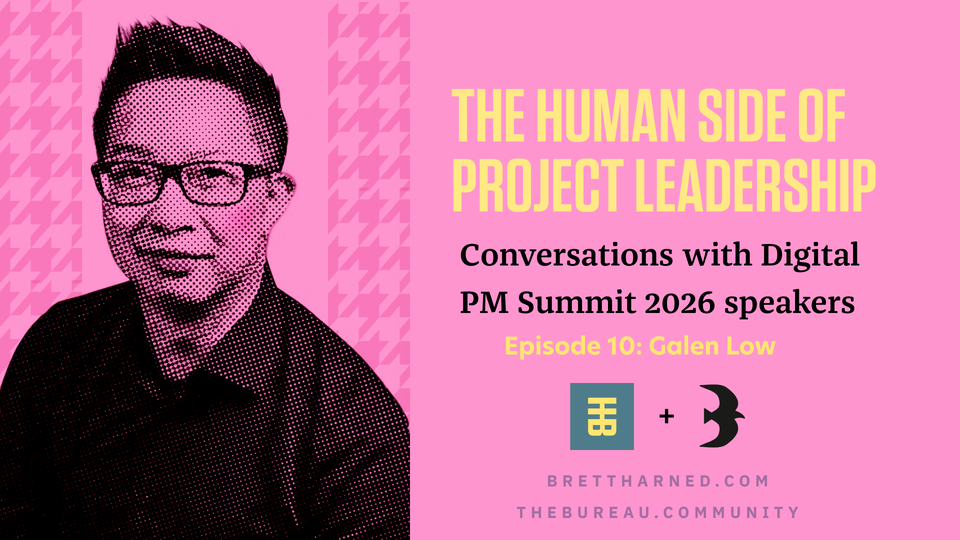
Your job title isn't your Future. Galen Low wants project managers to think bigger.
Project management is changing faster than ever, and nobody has all the answers. In my latest conversation for The Human Side of Project Leadership, Galen Low and I talked about AI, community, career resilience, and why the skills that make us valuable extend well beyond the PM job title.
When I first started writing and speaking about digital project management, we spent a surprising amount of time defending the idea that it was different from traditional project management. We were building websites, working with emerging technologies, and managing teams that were figuring things out as they went. The pace was fast, the requirements were constantly changing, and uncertainty was just part of the job.
Now, it feels like the rest of the profession has caught up.
That's one of the things my friend Galen Low, co-founder of The Digital Project Manager, pointed out when we sat down for the latest installment of The Human Side of Project Leadership. The ambiguity and technological change that once defined digital projects are now affecting just about every project manager, regardless of industry.
Galen and I have both spent years building communities around this profession, so we have a lot of shared history and perspective. With both of us preparing for Digital PM Summit in Asheville, I wanted to talk about how the profession is evolving, what AI really means for our careers, and why connecting with other people might be one of the smartest investments we can make right now.
Nobody has AI figured out. Let's stop pretending.
One of the things I've noticed in my consulting work is the gap between how people talk about AI and how they're actually using it. If you spend enough time on LinkedIn, you'd think every agency had automated its entire operation and every project manager was managing a team of AI agents.
That's not what I'm seeing.
At the recent AM seminar I hosted in Atlanta with Jenny Plant, one attendee was doing some incredibly sophisticated work with AI across the project lifecycle. Others were still trying to figure out where to start. And I suspect that gap exists in a lot of organizations.
Galen made a point that stuck with me: it's difficult to be an expert in something that was invented yesterday. Technology is changing so quickly that even the people who are deeply immersed in it are learning as they go.
That's why I think we need to get more comfortable admitting what we don't know. There's a lot of pressure to appear knowledgeable, especially when everyone seems to be announcing their latest AI breakthrough. But pretending we're further along than we are doesn't help anyone.
What does help is sharing what we're learning, asking questions, and being willing to experiment without knowing exactly where things will lead.
Community is more than a place to complain
Galen is delivering a lightning talk at Digital PM Summit about building career resilience through community, and I love that he's approaching the topic from his own experience.
Early in his career, he worked in an agency environment where project managers were competitive with one another. Sharing techniques or approaches wasn't necessarily encouraged because everyone wanted to be the standout PM. He also described himself as an introvert who wasn't particularly interested in talking shop outside of work.
My experience was almost the opposite. When I worked at Happy Cog, sharing knowledge was part of the culture. That environment encouraged me to write, speak, and connect with other people doing similar work. Eventually, it led me to help build the very community we're still bringing together today.
What I appreciate about Galen's perspective is that he recognizes how much his thinking has changed. Community isn't just about networking, finding a job, or having somewhere to vent about difficult stakeholders (although that's certainly a benefit). It's about learning from people who are solving problems you haven't encountered yet, getting perspectives you wouldn't otherwise consider, and having a trusted place to talk honestly about what's happening in your work.
With AI changing our profession so quickly, I think those conversations are becoming more important than any certification or training course. We need to learn from one another in real time, not wait for someone to publish the definitive guide to a technology that's already changed three times since the manuscript was submitted.
The human skills are still the hardest part
Of course, we couldn't talk about the future of project management without getting into what AI means for the actual work.
Galen sees the profession potentially moving in two directions for a while. Some PMs will focus on automation, systems, and orchestrating increasingly complex technology. Others will lean more heavily into leadership, communication, and helping people navigate change. He believes those paths will eventually come back together as we learn from one another.
I think he's right, and it's something I've been considering while writing the second edition of Project Management for Humans.
I've always believed that creating a project plan is one of the easier parts of our job. AI is making that work even easier, but it doesn't replace the judgment required to know whether the plan makes sense, whether the team is aligned, or whether we're solving the right problem in the first place.
Galen brought up risk management as an example of a skill we undervalue. Not the act of filling out a risk register, but the ability to have honest conversations about what could go wrong without making everyone panic. It's about helping people understand uncertainty, make thoughtful decisions, and feel confident that someone is paying attention.
That's a human skill. And as our projects move faster, I think it's going to become even more important.
Stop letting your job title define you
My favorite part of the conversation came when I asked Galen what advice he'd give to project managers who are worried about their future.
His answer was simple: Stop letting your job title define you.
I love that advice because I think we've become a little too attached to the title of project manager. We've spent years trying to define the role, establish its value, and convince organizations that we're more than task managers. And while that work has been important, it might also be limiting how we think about our careers.
The skills we develop as project managers apply to so many other roles. We know how to organize complex work, bring people together, navigate difficult conversations, make decisions, and create momentum. Those abilities are valuable in operations, strategy, product development, and leadership.
Galen wasn't suggesting that project management is disappearing. His point was that the craft may continue to exist even if the job titles change. I think that's an important distinction, especially for anyone feeling anxious about AI or wondering whether there's a future for them in this profession.
Instead of waiting to see what happens to the project manager title, we can start exploring where our skills might take us. We can learn new things, expand our perspectives, and look for opportunities we might have previously dismissed because they didn't have "project manager" in the job description.
And we don't have to figure it all out alone.
Join Us at Digital PM Summit
Galen and I will be continuing this conversation on stage at Digital PM Summit, October 19–20 in Asheville, North Carolina. I'm organizing and hosting the event, and I'm especially excited about our interactive session, Project Management Is Human, where we'll dig deeper into how the profession is evolving and what it means for the people doing the work.
Galen will also deliver a lightning talk about building career resilience through community. I'll be sharing some news about Project Management for Humans, Second Edition, coming in January 2027, and on October 21, I'll be facilitating a half-day workshop with Rob Harr focused on rethinking agency workflows with AI while keeping people at the center.
If you're questioning where your career is headed, trying to make sense of AI, or just looking for people who understand the challenges of this work, I'd love to see you there.
T L ; D R - Project management is changing, but the skills that make us valuable aren't going away. In this conversation, Galen Low and I explore why community matters more than ever, how AI is reshaping our roles, and why project managers should think beyond their job titles. We'll continue the conversation at Digital PM Summit in Asheville, October 19–20.

Member discussion