
The human side of project leadership #009
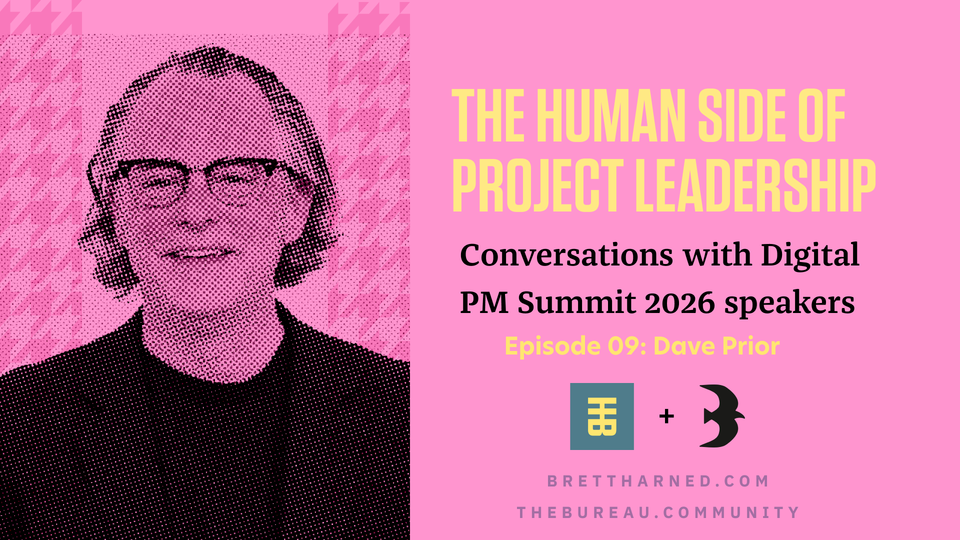
Project Management Is a Creative Profession. Dave Prior Wants Us to Remember That.
After 30 years in project management, Dave Prior still loves the work. In our latest conversation for The Human Side of Project Leadership, we talked about creativity, burnout, AI, and why finding joy in the job matters more than ever.
I've known Dave Prior for a long time. We first met at SXSW in 2011, when I was presenting a core conversation session called Project Management for Humans. At the time, few people in the industry were talking publicly about project management, so meeting someone who shared that interest was exciting. Dave has since been a mentor, a teacher, and a friend, and we've stayed connected through years of conversations about project management, Agile, and the many ways our profession has changed (plus our love of music, Philly, and lots of other stuff).
Now, as I'm preparing to launch the second edition of Project Management for Humans, it feels fitting to have Dave back at Digital PM Summit. He's delivering a keynote called Finding the Spark, and when he first pitched the idea, he wasn't entirely sure it was the kind of talk I wanted. I knew immediately that it was.
Dave has spent more than 30 years managing projects, coaching teams, teaching Agile, and helping people figure out better ways to work. He's seen plenty of change, and he's experienced his share of miserable projects. But he still genuinely loves being a project manager. I wanted to understand why, especially at a time when so many PMs are questioning their roles, their value, and whether they even want to keep doing this work.
The Creativity We Don't Always Recognize
Early in our conversation, Dave admitted that when he started working at Nickelodeon and digital agencies, he was a little jealous of the designers. They got to make things. They looked cool. Their work felt creative, while his involved schedules and all the administrative responsibilities that come with managing projects.
I could relate. I've always considered myself a "creative person," and at one point I seriously considered going back to school for design. Writing eventually became my primary creative outlet, but I also came to recognize something Dave has spent a lot of time thinking about: project management itself is a creative practice.
Dave describes working with a project team as being in a band. You bring people together, listen to one another, respond to what's happening, and create something that could only happen with that particular group of people at that particular moment.
I love that analogy because it gets at something we rarely acknowledge. We're not just organizing other people's work. We're designing the environment in which that work happens. We solve problems, navigate personalities, adjust plans, and help people collaborate in ways they might not have otherwise.
That takes creativity, even if nobody ever calls it that.
Creating Space Without Losing Yourself
A big part of my approach to human-centered project management is the idea that our job is to create the conditions for people to do their best work. Dave sees that as an act of service, and it's one of the things he finds most rewarding about the profession.
But that responsibility has a difficult side. Project managers invest an enormous amount of emotional energy in their teams and clients. We worry about conversations, anticipate problems, manage tension, and carry responsibilities that aren't always entirely within our control.
And we don't always get much recognition for it.
Dave talked about learning to find satisfaction in what other people accomplish because of the space he's helped create. That doesn't mean the job suddenly becomes easy or that we should accept being treated poorly. It means recognizing a different kind of reward, one that isn't necessarily tied to a perfectly executed plan or someone thanking us for keeping everything together.
We also talked about the confidence it takes to admit you don't have all the answers. Dave pointed out that many project managers are terrified of appearing uncertain, even though asking for help is often the smartest thing we can do.
That really stuck with me. I've seen PMs struggle with problems they could have solved much faster by simply bringing their teams into the conversation. We don't have to be the smartest person in every room. Sometimes the most valuable thing we can do is get the right people talking.
AI Might Give Us More Room to Be Human
Of course, we couldn't have a conversation about the future of project management without talking about AI.
Dave has worked across traditional project management, Agile, and now AI, and he's pretty direct about what's happening. Much of the administrative work we've historically associated with project management can already be automated or significantly accelerated.
That creates some understandable anxiety, especially for PMs whose roles have been defined by producing reports, maintaining schedules, and tracking project activity.
But Dave sees an opportunity in that shift, and I agree with him.
If technology can take on more of the administrative burden, we have an opportunity to spend more time doing the work that requires human judgment. We can focus on relationships, communication, creative problem-solving, and understanding what's really happening with the people around us.
That doesn't mean those skills are easy to develop. In fact, Dave argues that they may be harder to learn than many of the technical aspects of the job.
I've been thinking about this a lot while writing the second edition of Project Management for Humans. The tools are changing, but the need for thoughtful, capable people who can bring teams together isn't disappearing. If anything, we need to get much better at recognizing and developing those skills.
Finding Your Own Spark
One of the most interesting parts of our conversation came when I asked Dave how someone who's feeling stuck or burned out can reconnect with what they love about the work.
His answer wasn't about finding a better productivity system or learning another methodology. It was about understanding what restores you and deliberately making room for those things in your life.
Dave spent about a year figuring out which activities helped him maintain his energy and perspective. He now thinks of those activities as part of his personal disaster recovery plan. When things get difficult, he knows what he needs to do to get himself back to a place where he can show up for other people.
I think that's an important distinction. We spend so much time developing plans for our projects, managing risks, and preparing for things to go wrong. How often do we put that same effort into understanding what we need to stay healthy, engaged, and fulfilled?
Dave's point is that if we're going to make a career out of supporting other people, we have to take responsibility for sustaining ourselves, too.
And maybe that's what finding the spark is really about. It's recognizing what makes this work meaningful to you, protecting it, and making sure it doesn't get buried under everything else the job demands.
Join Us at Digital PM Summit
Dave will be delivering Finding the Spark as a keynote at Digital PM Summit, October 19–20 in Asheville, North Carolina. I'm organizing and hosting the event, and I couldn't be happier to have him back on stage.
At the end of our conversation, Dave mentioned that attending Digital PM Summit has always been restorative for him. He leaves feeling energized by the people, the conversations, and the community. I feel the same way, and it's a big reason I keep helping bring this event together.
If you've been feeling disconnected from the work, questioning your place in the profession, or simply looking for some new ideas and good people to talk shop with, I'd love for you to join us.
T L ; D R - Project management is more creative than we give it credit for. In this conversation, Dave Prior and I explore how PMs create the conditions for others to do great work, why AI might help us focus on the most rewarding parts of our jobs, and what it takes to sustain a career that demands so much. Dave will bring these ideas to the stage at Digital PM Summit in Asheville, October 19–20.

Member discussion